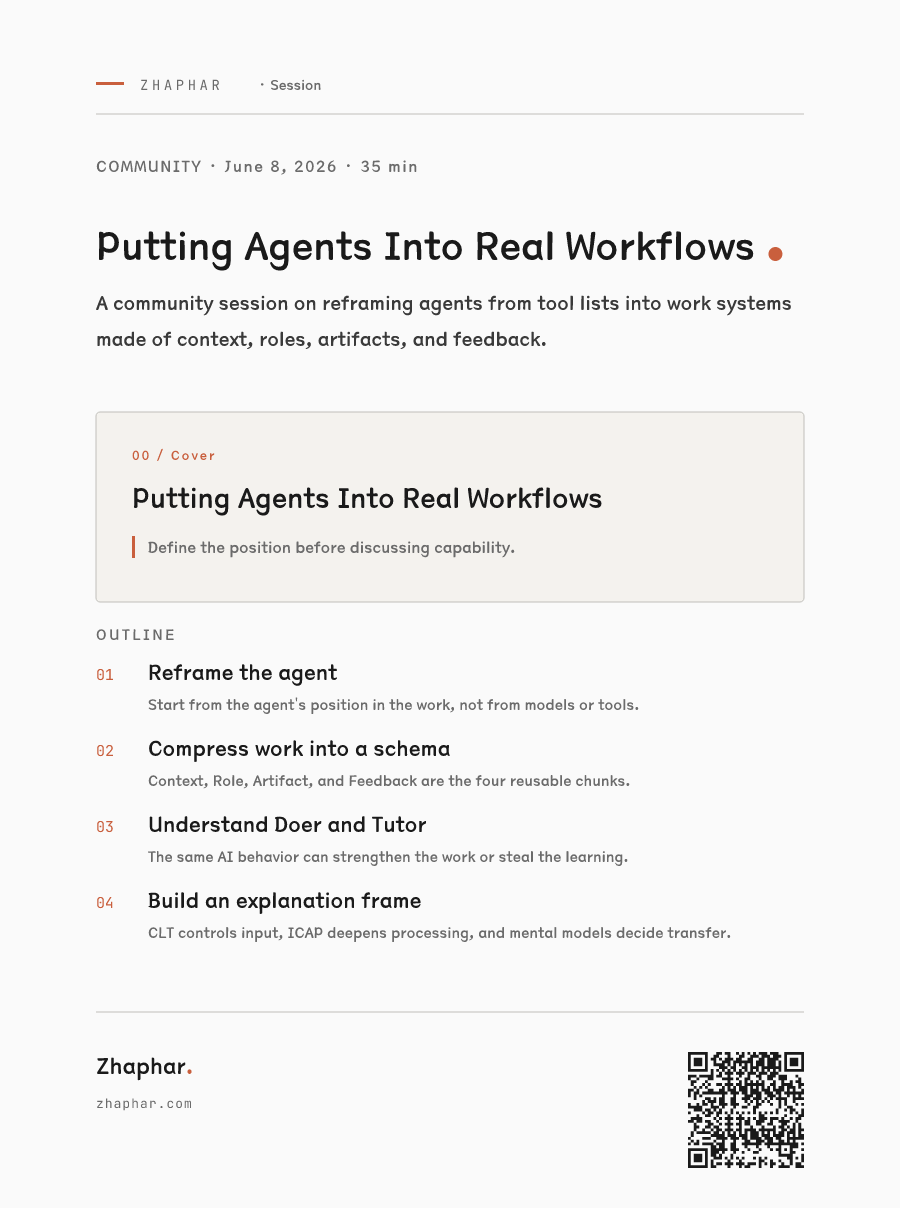
This session is not about a specific tool. It asks a more basic question: once agents enter everyday work, how should we reframe the work itself?
The answer I care about is structure: which objects deserve names, which steps can be compressed, and which mechanisms must keep human judgment intact. Without those boundaries, an agent becomes a more fluent but harder-to-manage black box.
Core claim.
The value of agents is not replacing every step. It is taking over frequent, describable, checkable intermediate work while helping people keep reusable representations, schemas, and mental models.
If a run ends without a structured artifact, and without making the next similar problem easier to judge, it was probably only a brief consumption of momentum.
Extract representations
Form the schema
Keep judgment
Tool list
Work system
An agent is not a tool list. It is a role inside a work system.
Context, Role, Artifact, and Feedback are the reusable chunks.
Doer and Tutor differ by whether the human still makes the key judgment.
CLT controls input, ICAP deepens processing, and mental models decide transfer.
The same agent workflow can be read through four knowledge layers.
Audience.
- —People using AI for writing, research, or development;
- —Builders trying to place agents inside project delivery;
- —Anyone tired of pushing every task into the same chat window.
— Discussion
GitHubDiscussion.
Discussion is powered by GitHub Discussions. Use it for follow-up questions, feedback, and notes after the session.
Discussion did not load this time. Refresh to retry, or continue on GitHub Discussions.